Return of delicate aquatic plant signals Chinese lake's revival_我的网站
一 |
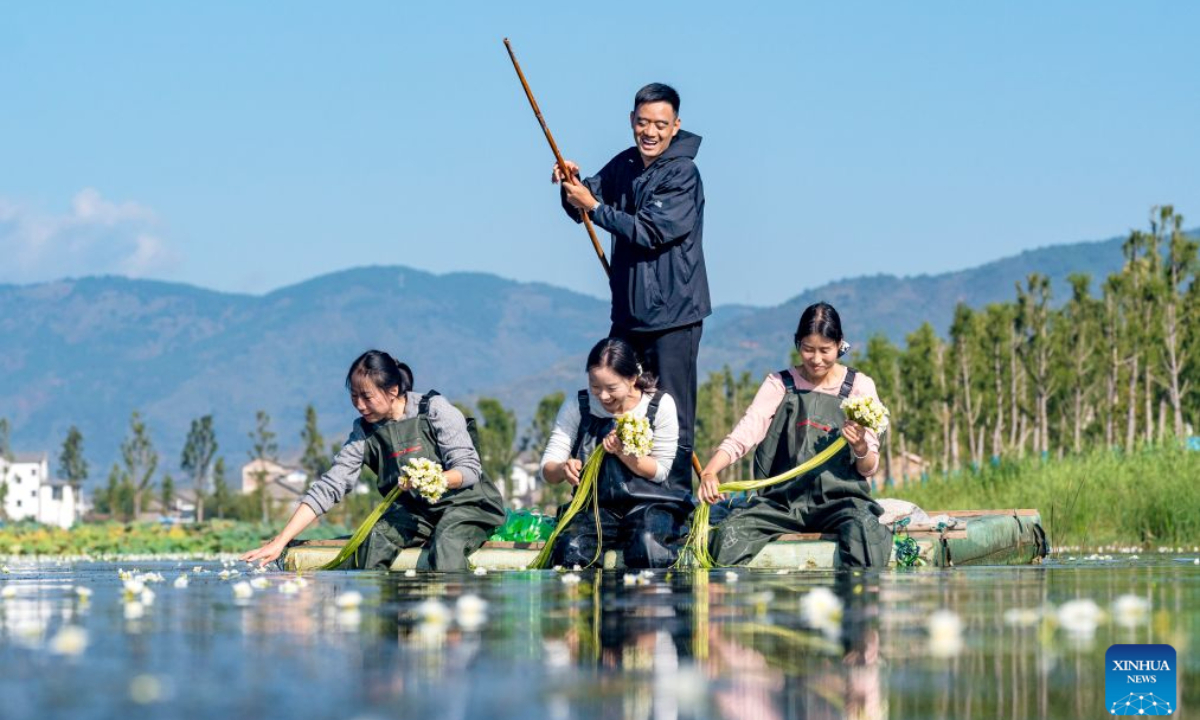
Workers harvest Ottelia acuminata at a planting base at Yong'an Village of Eryuan County in Dali Bai Autonomous Prefecture, southwest China's Yunnan Province, on Oct. 18, 2024.(Photo by Luo Xincai/Xinhua)Under the summer sun, Erhai Lake in southwest China's Yunnan Province glistens thanks to its clear blue water dotted with floating white blossoms. Tourists stroll and cycle around the spot, where limpid waters, lush mountains and blooming flowers combine in weaving a picturesque scene. The delicate blossom seen floating there is Ottelia acuminata, an aquatic plant endemic to China, which is known to have extremely strict water quality requirements. It demands high water transparency, cleanliness and calcium content, and survives only in unpolluted waters, serving as a reliable natural indicator of aquatic ecological health. Its large-scale revival vividly testifies to Erhai Lake's remarkable ecological restoration achievements. China's Ecological and Environmental Code, enacted on Saturday, stipulates nationwide protection and restoration of river and lake ecosystems, providing solid legal support for systematic water ecological governance across the country. As China advances its Beautiful China initiative, this code is expected to strengthen rule-of-law guarantees for ecological protection and provide fresh impetus for the country's green and low-carbon transition. In the early 1990s, agricultural pollution worsened Erhai Lake's water quality, causing frequent blue-green algae outbreaks. A severe algae bloom hit the lake in 1996, leaving the water turbid and smelly. As the environment degraded, Ottelia acuminata nearly disappeared from the lake. Thanks to years of targeted ecological protection and restoration efforts, the lake's water quality has improved steadily, maintaining an excellent Grade II standard from January to June 2026, and creating favorable conditions for the return of Ottelia acuminata. Official data show that the plant's coverage on Erhai Lake has surged from 90,000 square meters in 2021 to 950,000 square meters in 2026, marking a remarkable ecological recovery. The improved water environment has also brought tangible economic benefits, turning the lake's ecological advantages into a sustainable industry. From lake ecology to farm cultivation and consumer products, Ottelia acuminata's dual ecological and economic value has been fully realized. In 2018, environmental worker Zhong Lan noticed the edible plant's great potential for water purification and industrial development. With support from local authorities and Shanghai Jiao Tong University in eastern China, she started a company and built a professional research base in 2024, developing standardized planting techniques that enable high-yield, repeated harvests and offering jobs for local villagers. Villager Li Xinyuan, who quit Ottelia acuminata cultivation years ago due to low profits, resumed planting in 2023 and earns a stable monthly salary of 4,500 yuan (about 663 U.S. dollars) at the base. His fellow villager Du Hongquan earned over 100,000 yuan last year from growing the plant and has more than doubled his planting area this year. "The base takes full charge of sales, so we can plant without any worries," Du said. Eryuan County, the source of Erhai Lake, now has more than 200 hectares of Ottelia acuminata plantation area, creating numerous jobs yearly. The plant has been developed into a diverse range of products like tea, plant-based coffee and cookies. "I used to think it was exclusive to Yunnan, but I can try it elsewhere too," said a tourist surnamed Ai after tasting the plant at a hotpot restaurant in Hangzhou, east China's Zhejiang Province. The beautiful lakeside scenery at Erhai has also boosted local tourism. In 2025, Dali received over 120 million tourist visits, attracting visitors to enjoy lake views and experience local Bai ethnic culture, with 407,000 long-term visitors. Last month, the State Council issued a plan for building a Beautiful China during the 15th Five-Year Plan period (2026-2030), setting out the overall requirements, targets, key tasks and major projects for comprehensively advancing this initiative. According to the plan, China will achieve overall improvement in ecological and environmental quality and make significant progress toward building a Beautiful China by 2030, with green production and lifestyles largely established and the carbon peaking target reached on schedule. 。